Friday, April 24, 2009

Progress

I thought I would give a little progress report on my my marathon training.  I have been biking and swimming as well, but only as additional time allows.  For the last two months  I have prioritized running, and here is what I have to show for it.

Weight

My most significant limiter when it comes to running and so I set out an ambitious goal to lose nearly 35 lbs before the marathon  in July.  I admit that this goal is pretty extreme, and a severe diet is not conducive to retaining your muscle strength, but I tried haphazardly to lose weight over winter and I just wasn't successful.  Now that the pressure of the marathon is here I am hoping that it will provide that extra motivation that I need.  Also, I don't need to worry too much about losing weight too quickly as the higher your body fat percentage the more you can loose without having bad side effects.  I was starting out with a body fat percentage of 29% so I have plenty to lose.  Here is a chart of my progress so far.  The data has been smoothed by taking the rolling three day average.

As you can see, I started out losing a bit faster than expected and I got my hopes up a bit, but things have stabilized and pretty much I am losing weight on track to my goal.  So that is the good news.  I started out at 247.8lbs @29% body fat and was 235.6lbs this morning @26% body fat.  So that means I have lost 10.6 lbs of fat and 1.6lbs of lean tissue.  The small amount of lean lost was a happy surprise as I expected that I would lose more in what has been a pretty extreme diet.

Performance

So what effect has this had on my running.  I certainly feel much faster and a very easy pace for me is an 11 minute mile rather than a 12 minute mile, and my tempo pace has gone from 10:30 to 9:50.  I have also notice that my heart rate is generally lower for the type of run.  This has forced me to readjust my perceived effort levels of exactly what hard is.  So I am pushing myself a bit more, and going by pace in my workouts rather than heart rate.  Many times I only look at the heart rate data after the run is over and I am actually surprised that my heart rate was lower than I thought because the run felt hard.  This is all a sign of my threshold pace increasing which is all good.

My goal for San Francisco is to go 4:30.  It still sounds a bit out of reach but there are a few signs that are making this goal more realistic.  First, my training plan proscribes training paces based on "Planned Marathon Pace" and I can finally actually do these paces now where before I could not.  That is the first great sign.  

Second I did some Yasso 800s today and average 4 minutes and 24 seconds for 6 repetitions.  Supposedly if you can hold a pace for 10 repetitions that pace is a reasonable estimate of what you can do in a marathon if you change the minutes to hours.  So basically if I could have held that 4:24 pace for 10 full repetitions that would predict a 4:24 marathon.  I probably couldn't have done 10, but I think I could have done 8, so I am getting there.  

Lastly, I have been tracking my Polar running index.  This index is calculated by my heart rate monitor by comparing my heart rate to my pace.  It is a good predictor of VO2max and also running performance at various distances.  Here is a chart showing the upward trend in my Polar running index.


It appears I am at about 45 right now.  According to Polar that is on the cusp of "Average" and would predict a 4:15 marathon.  That seems much too fast to me, but in any case it is another sign that at least I am going in the right direction.  

Labels: , ,

Wednesday, February 18, 2009

Oh, to be Average

I recently read this blog post by Matt Fitzgerald, a writer on running and triathlon training.  He talks about the "running index" function on Polar heart rate monitors.  Basically, the monitor takes some basic information, such as your heart rate and running pace and puts it together to get a number, and this number can be used to compare your run against other runs that you have done, or even against other people.  The index is somewhat correlated to VO2max so it can track fitness over time and also can be used to predict performances at various distances similar to Jack Daniels VDOT pace tables. I have a Polar device and noticed the number, but up to this point I hadn't paid any attention to it.   After reading the article, I wondered what my numbers were.

This is a chart of my running index numbers since January first.  You can see that they slowly moved up to a 50 on 1/31/09.  It was pretty consistent too, except for the poor run on 1/18/09 where I got a 32.  That run was a trail run on an unfamiliar trail and I did a little bushwhacking, so it is to be expected that the run wasn't very good.  You can also see that there is a big gap after 1/31 where I missed quite a few runs, and now my score is back down again.  I can feel the fitness lost and here you can see it one the chart.  Actually its pretty amazing.  This running index thing might be more interesting than I originally thought.

In the user manual for my Polar device there is a chart that rates he running index number.  50 is in the "average" range.  Wow, I have a hard time believing that I could be average at running.  I think that is pretty incredible in itself.  To think that I could be average at my worst sport.  It also estimates a 4hr marathon time for someone who can average a 50 running index over time.  That just happens to be my stretch goal for the San Francisco marathon, so that is great news.  I just have to work on getting the running index number right back up there.

Labels: , ,

Tuesday, March 04, 2008

LA Marathon Photo Log

Saturday, February 02, 2008

Running Update

I have this track record of doing a race and then taking forever of putting up my race reports. First I have to wait to get some photos. Then I have to write it up. By that time it is so late that I think I shouldn't even bother. Oh well. Here are a few photos of me running the Inuagural Rose Bowl Half Marathon in December.


I paced myself pretty well and gave it a good kick for the final 400 meters. I was fine for about 2 minutes after finishing and then the pain set in. The next day I could barely walk. My time was 2:19:27.

The LA Marathon is off. It was a hard choice. The Holidays messed up my training a bit, but I was getting back on track. I had a couple injuries, but I was dealing with them just fine, and then I got slamed with a chest infection and there went two weeks of training. When I started back up again I couldn't run more than 5 miles and even then my heart rate was going through the roof at even a very slow pace. I still worked at it and it is improving. but there is no way I will be ready by March 2 without really pushing myself to the extreme and risking a serious injury. So I have been trying to do more cycling lately and then my chest cold is back... I guess I should just forget early spring events from now on. My winter training just sucks!

However, I don't want to give up on the marathon goal just yet. Instead of the LA Marathon I'm thinking of doing a self supported (or rather family supported) event in April or May. That would give me enough time to get back on track and hopefully be injury and illness free.

Labels: , ,

Friday, November 30, 2007

FIRST Marathon Training Plan

As I mentioned in an earlier post I'm following the FIRST Marathon Training Plan. the plan I am following is for first time marathoners, but that is not why it is called FIRST. FIRST stands for the Furman Institute of Running & Scientific Training. The plan (as do all of them I believe) is based on the principles I described in post yesterday about the three intensity zones. Every week you have three run sessions and each session focuses on one of these zones. Other days of the week you do cross training. I think these plans are especially valuable for triathletes since we have so much crosstraining to do and rarely have time to run much more than three times a week. I also purchased the FIRST running book and I'll let you all know what I think.

Labels: , ,

Thursday, November 29, 2007

Threshold Run Testing

So a couple of months ago, when I got this crazy bug to do a marathon, I decided to do a running lactate threshold test. Last year I did one in the lab for the bike. In the lab it is a simple measure of blood samples taken when producing a progressively harder and harder power load. What did I learn? Mostly that I have a little strength but I am incredibly slow because of a poor power to weight ratio, but then again I already knew that. I am reminded of just how weak and slow I am on my weekly ride up Mt. Wilson. So what is the point?

The point is to train with the proper intensity so that I can make the maximum possible gains. I don't just want to finish the LA Marathon - I want to do it faster than I ever thought possible. A four hour marathon is probably unreasonable, but maybe four and a half hours is doable with the right training. Slow for some people but incredibly fast for me.

The goal of threshold testing is to find that level of effort (which is sport specific) at which your body no longer can supply its energy needs from the burning of fuel with oxygen (i.e. aerobically). Once you go above this level, the body can still supply additional energy but it will be without the use of oxygen (anaerobically) and will result in the acidic waste product lactate which is associated with fatigue. So theoretically the threshold is the maximum level of intensity that can be sustained over an extended period of time because only a small amount of lactate is produced.

Once equipped with your threshold you can tailor your training regimen to maximise the returns. There are three basic intensities at which to train, each of which have their own benefit. Sub-threshold training is at an easy pace, well below the threshold. This intensity level develops basic endurance and stimulates increased vascularization (i.e. more blood vessels and capillaries). Because the point of these workouts is endurance they are usually the longest you will do and also sometimes called Base miles or LSD for long slow distance.

The second level is Threshold training in which you train at or slightly above your threshold. This training is aimed at raising your threshold level, thus increasing the work that your body can perform on a sustained basis. The body responds to these workouts with increased efficiency in oxygen uptake, usually through an increase in the number of cellular mitochondria, as well as developing an increased ability to utilize or buffer lactate. So even when lactate is being produced at a high level it is also quickly being removed, avoiding the buildup of lactate and its associated fatigue. Tempo runs are a classic threshold workout, but there are others such as tempo intervals, cruise intervals, etc.

The last level is Supra Threshold training, also known as speed work or interval training. This training involves relatively short and intense efforts that greatly exceed the threshold level. because they exceed the threshold level they become anaerobic, but they still have benefits for aerobic performance. First by running faster you can learn the proper form and develop the proper neurological firing of the muscles. What is really being developed is efficiency. As these skills improve they will also improve the efficiency of slower running.

So there you have it. The three basic training levels. Here is a great resource by Greg McMillan listing the major types of runs that you can do which fit into each intensity level.

So finding your threshold level is good, but I didn't want to pay $200 to have it determined in the lab. If you have that kind of money to spend on these tests that is all well and good, but I would rather save the money for a time trial bike, thank you very much, and in any case you probably want to test yourself every month or so to measure your progress and keep your training plan up to date. So I did the threshold test advocated by Mike Ricci of D3 Multisport. Joe Friel also has a similar test in his book, The Triathlete's Training Bible (2nd Edition).

To do the test you need a heart rate monitor (but absent a heart rate monitor I suppose you could also just use your your pace if you had an easy way to measure it such as on a track and on the bike you can certainly use a power meter). I preprogramed my HRM with the various stages of the test, but you don't need to do this as the test is very simple. I started with a 15 minute warm up. After the warm up you do a 30 minute time trial. The idea is to go as fast as you can for thirty minutes such that at the end you feel that you could not have gone any faster, but not so fast that you have to slow down during the time trial. The pacing is a little tricky for a novice and the first time I did the test I had to slow down quite a bit right around half way through the time trial, which probably screwed up the test. The second time I did it, I was ok. So there is a little learning curve, but it's not too bad. During the time trial you want to press the lap button after ten minutes and then again at the end of the thirty minutes. This way the heart rate monitor will give you the average heart rate for the last 20 minutes of the time trial. This average is your threshold, and is exercise specific. That is, you need to test running and cycling separately. I recommend a cool down after the time trial, but for the purposes of the test this is optional.

I did the test yesterday and got the average of 161 beats per minute at a 9:58 pace. It was slower than I had hoped, but man was it an improvement over my last test. It was a whole 4 beats per minute greater after only 8 weeks of training, and my pace was about 32 seconds per mile faster. I can definitely live with that.

Labels: ,

Wednesday, November 28, 2007

Back in the Saddle

So I have been away for awhile. I decided that other areas of my life, such as my family and my career need more attention, so I scaled my training hours back severely and focused more on one sport, running, since it is my greatest weakness. A couple months ago I got the great idea to do the LA Marathon to give myself a goal, but I guess I could never really commit to it. I thought maybe it would be too much of a commitment given the fact that I am supposed to be focusing on other areas of my life right now. But I tried just "working out" for a few weeks and it was really hard. I just don't have the motivation to just burn calories -- I need a goal. So I signed up for the marathon. It's official!

I also have the Rose Bowl Half Marathon in two and a half weeks. Fortunately I have been running enough to still be prepared. I did a thirteen miler this past weekend and will be in taper mode for the next two weeks.

Labels: , ,

Thursday, May 24, 2007

Doing the Holger

Since my ocean swim was cut rather short yesterday I tried going for a little longer run. I have been working on my speed lately and usually that means intervals. I do a good 5 to 10 minute warm up at a 12 minute per mile pace and then try to kick it up a notch to a 10 minute mile pace for around five minutes. My heart rate usually jumps up to 90% and then I rest by slowing back down to a 12 minute per mile pace for five minutes or so. Then I just repeat this over again for the rest of the session. So far this has been a success. I have noticed a decline in my heart race for relatively higher speeds. I can now run about an eleven minute pace at the same heart rate that I used to get from a twelve minute pace.

I also have to work on my form. As I increase my speed there are opportunities to improve my form. For example, a common drill that runners do is butt kicks. You run and try to get you legs to continue up past horizontal after each push-off until they touch you butt. This is really exhausting to do if you are running slowly, but as your speed increases these kinds of drills make more sense. If you are running slowly and have a proper cadence (around 90 steps per minute) then your stride is very short and it would take a whole lot of extra energy to push you legs back that far. All that extra energy is just wasted, but as you increase your speed your stride opens up and it becomes more natural. As speed increases raising your leg behind you actually becomes an energy saver in that it decreases the length of your leg as it swings forward with each stride. Why is this important? Because you leg acts as a pendulum when it swings forward, and the shorter the pendulum the quicker it will swing simply from the force of gravity, and it will require less work from your hip flexors. Essentially, you can move faster and use less energy, which is what running efficiency is all about.

Another aspect of form to pay attention to is the arms. Most runners keep their arms at about a ninety degree bend at the elbows. Ideally you pump the arms straight forward and back and minimize the movement of the shoulders and torso. Moving your arms takes much less energy that your shoulders or core. You may have noticed that some runners, as fatigue begins to set in, tighten the shoulders and raise their arms. All this does is cost the runner more energy. By decreasing the arm angle the arms are becoming shorter, and as short pendulums they require less energy to move, but unlike the legs this is not a good thing. This is because the movement of your arms is to counter balance the movement of your legs. Without a strong pumping of the arms the entire upper body and core will have to compensate by moving. Your shoulders will move back and forth and this is much more costly in energy terms than moving your arms.

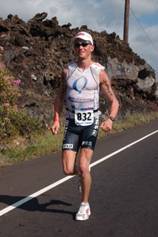
I tried something out the other day that I call “Doing the Holger.” I mentioned Holder Beckmann before, another member of my tri club. He is a great athlete and a great guy, but he does have a unique running style. As you can see from the photo he keeps his arms almost straight as he runs. It looks a little unusual, but actually it is not that uncommon among endurance runners. My theory on this style is that by lengthening the arms he is creating large pendulums that can easily counter balance his legs without moving very much. Less movement means less energy expenditure and more efficiency.

So I tried it out. It definitely feels strange at first, but as I got into a groove I looked down at my Polar S625x heart rate monitor to check my speed, and I was going a whole mile per hour faster than my usual ten minute per mile pace with no noticeable increase in heart rate. It was really working! So I kept it up and averaged six point six miles per hour for the last third of my five and a half mile run. Another breakthrough.

Labels: , ,