How to destroy your bike
I've been riding quite a bit lately. I'm building up for a the LA Wheelmen Grand Tour Double Metric Century Challenge (whew, that's a mouthful!) in late June. So that means lots of long epic rides and mostly in the mountains. I have gone farther than I have ever imagined and still the longest ride I have done has been only about 75 miles, which is still a long ways off from reaching at least a century ride before the double metric century (about 126 miles.)
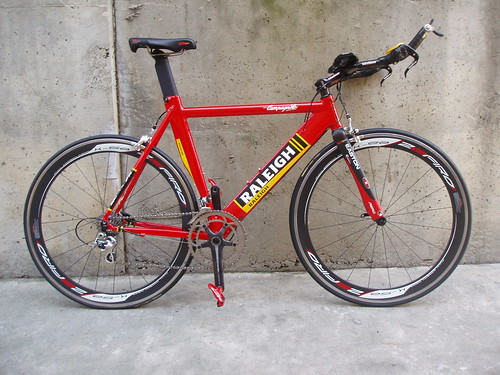
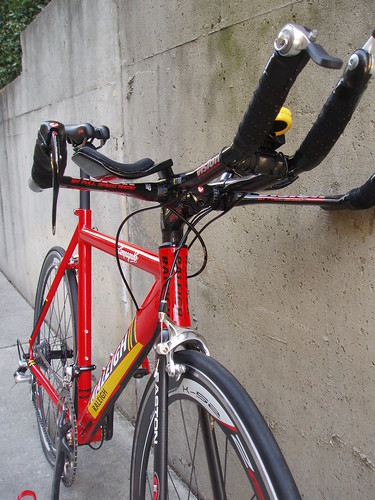
So I have a long ways to go, but I have a sprint triathlon coming up next week so I thought I would get a little more experience in the flats on my triathlon bike. Yesterday I took my Raleigh out for a spin along the San Gabriel River Trail. I started in Duarte and the idea was to go hard and fast to the ocean and back. Instead I destroyed my bike. Ok, maybe that is an overstatement, but I completely ripped the rear derailer off. The rear hub may be damaged, the cassette may be toast and the front big chainring may be bent as well.
So what happened? To understand how this could happen I have to explain about rear derailer cage capacity. The cage is the arm that hangs down from the derailer and holds the two pullys that the chain runs through. The job of the cage is to direct the chain onto the proper cog, but also it functions to take up the slack in the chain. The longer the cage the more slack it can take up and the more "capacity" it has. For the drivetrain to run properly the chain needs to be long enough to wrap around the two largest gears (the big chainring in front and the largest cog in back) and also have a cage that can take up the slack while the chain is in the two smallest gears (small chainring, small cog). The larger the difference between the rings in either the font or the back will increase the difference in chain lengths required in these two positions and thus will require a greater cage capacity. Campy rear derailers come in either short, medium or long cage. The longer the cage, the greater capacity, but also the greater weight and slightly slower shifting response. Generally people who are concerned with performance go with the lowest cage length required.
On my road bike I have a compact crank which requires an increased capacity and also I tend to run a 13-29 cassette for climbing, which also requires a greater capacity, so on my road bike I have a medium cage rear derailer. A medium cage will handle just about anything short of a triple crank with no problems. I wanted to get a medium cage for my tri bike as well, but when I ordered my parts I forgot to specify that I wanted a medium cage and was instead sent the more common short cage. The short cage will work for a standard crank and any cassette with the lagest cog of up to 27 teeth. I didn't want to do through the hassle of sending the thing back and I have a standard crank on the bike and don't plan on using it for climbing so I figured a shart cage would be fine.
Generally it is fine, unless I use my climbing 13-29 cassette. When I use that cassette the chain will jam when I am in the big chain ring in front and the large cog in back (every other combination shifts fine), but since I wasn't planning on using the tri bike for climbing why would I need to use that cassette. And if I did use that cassette then I just need to stay out of the big/big combo. I'm not supposed to shift into that combo anyways because it is cross chaining and bad for wear and tear on your bike anyways. So every time I ride the bike I either put on a 12-25 cassette or just be careful to not shift into the big/big combo.
So now it should be obvious what happened. I was too lazy to swap cassettes when I moved my powertap wheel from my road bike to my tri bike. Then about an hour into my ride I was powering along on the flats in my big chain ring when I can across a short steap hill. I didn't shift soon enough because I thought my momentum would carry me up most of the hill, but I misjudged how steep it was. Then I had to quickly downshift and while I was specifically trying to avoid shifting it into the largest cog I accidently shifted it one gear too many. There was his horrible metal crushing sound and the bike stopped instantly. I was fortunately able to clip out in time, but the bike was really messed up. The rear derailer hanger had been torn in two and my beautiful carbon chorus derailer was bent and mangled and jammed on top of the cassette. I was able to remove the rear wheel and pull the mangled bits out, but that was the end of that ride.
It looked like I was going to have to walk over 15 miles bake to my car barefoot, but fortunately my wonderful wife was able to pick up my sorry ass on her way to work. Looks like I'm riding my road bike in the triathlon next weekend.
posted by Paulie at 10:21 AM
0 comments